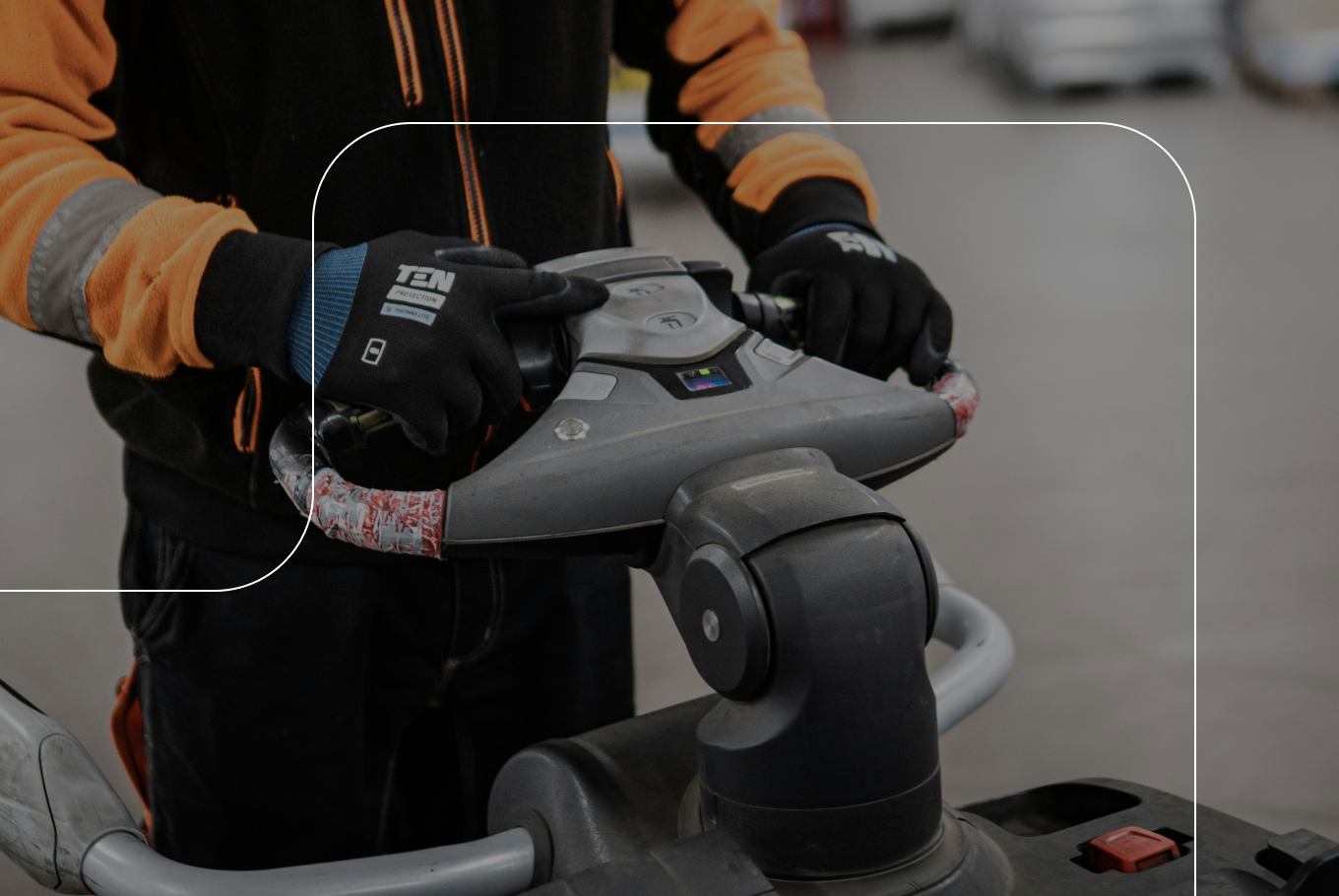
Forklifts were the source of 84 work-related deaths in 2024 and 25,110 nonfatal injuries involving days away from work, job restriction, or transfer during 2023 and 2024. Speed is only one part of forklift safety, but it becomes particularly important around intersections, pedestrians, blind corners, loading areas, and other locations where operators need enough distance to stop safely.
OSHA does not prescribe one universal forklift speed limit. Instead, its guidance requires powered industrial trucks to travel at a safe operating speed based on factors such as the truck load, stopping distance, surface conditions, and pedestrian traffic. Modern forklift speed monitoring systems help safety teams enforce site-specific policies more consistently by detecting speeding, applying zone rules, generating alerts, or, in some configurations, automatically limiting vehicle speed.
Forklift speed monitoring technology helps industrial facilities identify or control vehicles traveling faster than site conditions permit. Depending on the system, speed information may come from computer vision, telematics sensors, radar, positioning technologies, or onboard vehicle integrations.
The distinction between monitoring and control matters. Some systems observe vehicle movement and alert safety teams when a threshold is crossed. Others connect directly with the forklift and automatically reduce its speed when the vehicle enters a defined zone or when another safety condition is triggered.
OSHA requires powered industrial trucks to operate at speeds that allow them to stop safely. It also instructs operators to slow down on wet or slippery surfaces, at obstructed cross aisles, and while negotiating turns. Monitoring technology can give safety teams a more consistent way to see whether those expectations are reflected in day-to-day operations.
The best fit depends on whether a facility needs visibility, direct vehicle intervention, or both. Important capabilities include:
Voxel is an AI-powered industrial intelligence platform that uses existing security cameras to identify vehicle and workplace safety risks. Its vehicle safety detection capabilities include speeding, unsafe vehicle-pedestrian proximity, near misses, and failure-to-stop events.
Unlike an onboard speed governor, Voxel does not need to be installed on every forklift to observe speed-related behavior in camera-covered areas. The platform is designed to help safety teams see recurring patterns and move from individual detections to corrective action.
Voxel is particularly relevant for operations seeking facility-level visibility into speed and other vehicle behaviors without equipping each forklift with dedicated monitoring hardware. Voxel reports compatibility with more than 95% of existing IP cameras and says its AI can adapt to a new environment within 48 hours.
Published customer results provide additional vehicle-safety context. Piston Automotive reported an 86% reduction in vehicle safety incidents over three months, while the Port of Virginia reported a 50% reduction in truck speeding within six months. These are individual customer outcomes rather than guaranteed results for every deployment.
OneTrack provides industrial camera and AI systems for warehouses and factories, including forklift-mounted cameras. Its forklift monitoring approach combines video information with operational data so teams can review vehicle use and operator behavior.
OneTrack materials describe forklift monitoring as including information such as vehicle location, speed, utilization, and operator behavior. Its camera systems can also provide visual context around safety events.
OneTrack is relevant when a facility wants vehicle-level visibility that travels with the forklift. Because cameras are mounted on the equipment, supervisors can review what was occurring around the operator and vehicle when an event happened.
This model differs from facility-camera analytics because implementation occurs at the vehicle level. Organizations should evaluate how many forklifts need coverage and whether speed observation, operator context, or direct speed control is the primary requirement.
Powerfleet offers an onboard Speed Manager designed specifically to reduce forklift speed in response to configured safety events. The system can work alongside Powerfleet's forklift gateway and pedestrian proximity technologies.
Speed Manager supports two configured speeds and controls travel in both forward and reverse directions. Powerfleet states that it is designed for many forklift makes and models using electronic throttles.
Powerfleet is one of the more direct options for facilities where automatically influencing forklift speed is a core requirement. Speed can be reduced after specified events such as pedestrian detection, impacts, or other safety conditions.
Because the system interfaces with the forklift, compatibility should be confirmed for each vehicle type. This approach is fundamentally different from camera-only monitoring because it can act directly on vehicle speed rather than only detecting an event.
Trio Mobil combines industrial AI, proximity sensing, and positioning technologies for forklift and pedestrian safety. Its solutions include intelligent safety zones that can trigger alerts or forklift slowdown based on location and risk conditions.
Some Trio Mobil configurations combine AI vision with ultra-wideband technology. This allows facilities to use different detection methods depending on the physical environment and desired zone-control strategy.
Trio Mobil is suited to facilities that want speed behavior tied closely to designated risk zones. For example, a forklift can operate normally in a lower-risk area and be configured to slow when entering a location with greater pedestrian exposure.
The combination of positioning and AI also gives facilities options for environments containing racks, corners, or other features that can complicate line-of-sight monitoring.
Blaxtair provides AI-based industrial vehicle safety technologies covering pedestrian detection, vehicle detection, zoning, shock detection, and fleet analytics. Its current forklift solutions also include automatic speed limitation in designated higher-risk areas.
The system can apply a reduced speed within configured zones and restore the normal speed setting when the forklift returns to a lower-risk location.
Blaxtair is relevant when operations want speed control to change according to specific areas of a facility. High vehicle-pedestrian interaction zones, narrow aisles, and other designated locations can receive different treatment from lower-risk travel areas.
Its broader safety platform also connects speed management with pedestrian and vehicle interaction data rather than treating speed as an isolated metric.
ELOKON's ELOspeed focuses on a specific forklift speed-management challenge: controlling the transition between outdoor and indoor operating areas.
The system uses radar to recognize structures associated with indoor environments. When a forklift moves indoors, ELOspeed can automatically reduce it to a configured speed and permit higher travel speeds again when it returns outside.
ELOspeed has a narrower focus than broad analytics platforms. It is designed around facilities where forklifts routinely move between outdoor yards and indoor production or warehouse areas.
That makes it particularly relevant when the primary speed-management problem occurs at entrances and transition points rather than across many different behavior categories.
Samsara provides a broader connected-operations platform that covers fleet telematics, equipment monitoring, cameras, reporting, and operational workflows. In 2026, the company introduced a 360-degree camera designed for operated equipment including forklifts and pallet jacks.
Samsara also supports tracking for powered equipment, including forklifts, through its equipment-management technologies.
Samsara is a broader operations platform rather than a dedicated forklift speed-control product. Its relevance is strongest where forklift visibility needs to sit alongside other vehicle, asset, and operations data.
Facilities for which forklift speed thresholds or automatic slowdown are essential should verify the exact supported configuration during evaluation rather than assuming that general equipment tracking provides dedicated speed enforcement.
Intenseye uses computer vision AI to monitor workplace safety through facility cameras. Its vehicle-control capabilities cover speed patterns, vehicle-pedestrian proximity, wrong-way travel, congestion, and other traffic risks.
The system can use camera feeds to provide safety teams with continuous visibility into movement across higher-risk areas.
Intenseye is a camera-based option for facilities that want to monitor vehicle behavior without making every forklift the primary point of installation.
Its ability to evaluate speed alongside direction, proximity, and traffic patterns can help EHS teams understand where vehicle risk repeatedly concentrates. It is primarily a monitoring and analytics approach rather than an onboard speed governor.
Protex AI uses computer vision with existing CCTV systems to monitor workplace safety and operational activity. Its vehicle controls can be configured around vehicle type, zone, distance, speed, direction, and count.
That allows forklift movement to be evaluated according to rules defined for individual areas of a facility.
Protex AI is relevant for facilities seeking configurable visual monitoring of vehicle activity rather than physical speed intervention. Teams can define different rules around the types of vehicles and zones they need to observe.
Its computer vision model can also connect speeding with related issues such as unsafe proximity or traffic flow, helping safety teams review broader patterns around forklift movement.
SIERA.AI develops forklift-mounted safety technologies incorporating machine vision, pedestrian detection, telematics, and vehicle controls. Its S3 product family includes configurations designed to slow a forklift when a detected risk reaches a defined threshold.
The company also supports configurable speed settings for its Slow to a Safe Stop configuration.
SIERA.AI is oriented toward vehicle-level intervention. Rather than relying only on a supervisor to respond after a speed-related event, certain configurations can interact with the vehicle when defined safety conditions are reached.
Facilities considering this approach should evaluate forklift compatibility, installation requirements, detection distances, and how automatic slowdown rules will affect normal material-handling workflows.
Voxel stands out in this category because it treats speeding as one component of a larger vehicle-risk picture. Through AI vehicle monitoring, safety teams can identify speeding alongside unsafe stops, forklift-pedestrian proximity, and near misses using cameras already installed throughout the facility.
The platform also connects detections with follow-through. Events can become alerts, assignments, coaching opportunities, and measurable safety trends rather than remaining isolated pieces of video.
Published outcomes show how that approach has worked at individual customer sites. Verst Logistics reported an 82% drop in vehicle safety incidents and a 92% drop in no-stop-at-intersection incidents, while the Port of Virginia reported a 50% reduction in truck speeding.
Voxel also reports that its AI has been trained on more than 5 billion hours of industrial workplace scenarios and that its site-specific models achieve more than 95% detection accuracy. For multi-site industrial teams, that combination of existing-camera deployment, vehicle-risk context, and corrective-action workflows provides an alternative to treating forklift speed as a standalone telemetry metric.
Teams evaluating facility-wide vehicle risk can book a demo to review camera coverage, safety priorities, and deployment requirements.
Forklift speed monitoring software can identify vehicle speed, speeding events, travel zones, and recurring patterns by location or time. More advanced systems may also connect speed with pedestrian proximity, stopping behavior, impacts, or traffic direction. Voxel vehicle safety, for example, monitors speeding alongside unsafe stops, proximity events, and near misses through existing camera infrastructure.
No. OSHA does not set one universal numerical speed limit for powered industrial trucks. It requires forklifts to travel at a speed that allows them to stop safely and considers factors such as the vehicle, load, stopping distance, surface conditions, and pedestrian traffic when evaluating safe operation.
Computer vision platforms can analyze footage from appropriately positioned cameras to identify vehicle movement and speeding events. This approach can provide coverage of intersections, aisles, pedestrian interaction areas, and other monitored zones without installing a separate camera on every vehicle. Voxel's safety platform uses existing facility cameras to surface vehicle and other workplace safety risks in real time.
Some systems can, but not all speed-monitoring technologies are designed to control the vehicle. Onboard technologies may connect with the forklift to apply a lower speed under defined conditions, while camera analytics generally focus on detection, alerts, evidence, and follow-up. Voxel vehicle detection belongs to the latter category, giving teams visibility into speed and related vehicle risk without positioning itself as an onboard speed governor.
Speeding data is most useful when teams look for patterns rather than treating every event as an isolated violation. Repeated events at one intersection, shift, or pedestrian crossing may point to traffic design, coaching, signage, or operating-process issues that need attention. Voxel's risk platform supports this broader approach by connecting detected risks with trends, follow-up actions, and reporting.

Explore AI Summary