Voxel Acquires Ventral to Boost Operational Capabilities and Increase Value for Our Customers.
Learn More
It’s hard to believe that we’re already at the third installment of our three part series: AI for Safety Pros. We’ve been hosting these webinars and writing these blogs to demystify Artificial Intelligence in workplace safety and demonstrate its importance to modern safety professionals.
AI 101: Smarter Tech, Safer Workplaces broke down four categories of AI and how they can each be applied to help make workplaces safer. AI 201: Applied AI and the Future of Workplace Safety zoomed in on Computer Vision AI and how it can be used to detect risks such as improper ergonomics and dangerous vehicle behavior.
Here in the thrilling conclusion, AI 301: Operationalizing AI for Safety, we will first look at how we use Computer Vision AI to enable customer teams. Then, we will examine a couple of amazing real world examples of what happens when customers partner with Voxel to empower their safety teams using Computer Vision AI. I had the pleasure of co-hosting this webinar with Ashley Salzman, Voxel’s Senior Customer Success Manager. Watch the webinar here.
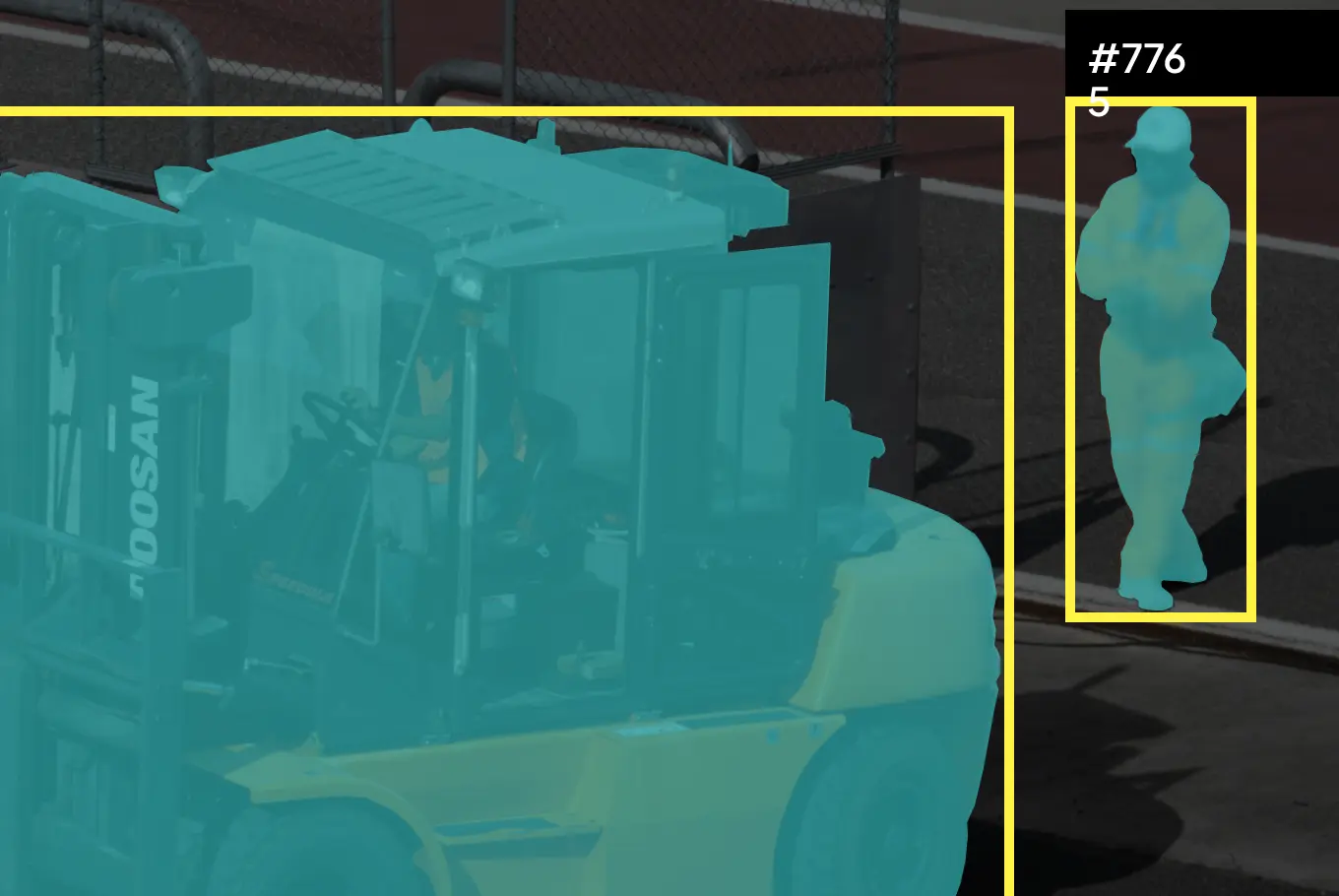
We use Computer Vision AI (CVAI) because we believe that the majority of workplace injuries are preventable, and that CVAI is an incredibly powerful tool for preventing them. At its core, Computer Vision is an advanced pattern detection or recognition system that looks for risky conditions and flags those conditions.
We use it by leveraging existing CCTV infrastructure to identify hazardous behaviors and conditions in real-time. Our AI detects risks like ergonomic issues, unsafe vehicle operations, personal protective equipment (PPE) compliance, and environmental hazards. It also helps finds ways to increase operational efficiency.
Once our Computer Vision AI has identified and flagged these issues, we present them with an easy-to-read dashboard, using data visualization tools such as interactive dashboards, impact boards, and heatmaps. We also provide video of any incidents or near misses complete with built-in anonymization blurring to protect worker privacy. With Voxel’s CVAI, teams can communicate clearly, intervene proactively, and track trends across different sites and teams.
We do not see customer success as a support function. We see it as a strategic enabler for long term safety transformation." Ashley Saltzman
Deploying AI is only one part of our job. Equally critical is strategically embedding use and understanding within organizational workflows and culture. We don’t see customer success as a support function, we see it as an enabler for a long term safety transformation.
Whenever Voxel partners with a new customer, we see it as a partnership for long term for long term impact. In order to do that, we think about the entire life-cycle of safety innovation and consider three broad phases:
Let’s take a look at how we empower our customers in each of these phases:
Time and time again, we find that upfront investment sets the tone for long term impact and empowers teams from the ground up.
Co-define Success Metrics: We dedicate time to clearly define success metrics with our customers’ teams. Together, we identify goals such as an overall reduction of leading indicators for specific event type and learn the needs of every specific location.
Deploy Insights: Early and consistent deployment of insights impacts decision making from the jump. This real-time feedback mechanism helps teams quickly recognize and respond to emerging safety trends, and makes sure that issues are addressed proactively.
Onboard and Enable Frontline Teams: We emphasize comprehensive onboarding and enablement for frontline workers, empowering them to actively participate in creating a safer workplace and improved safety culture. Engaged and informed workers make a huge difference when it comes to building a sustainably safe worksite.
As the data pours in, we make sure to work with our customers to translate that information into meaningful solutions with lasting impact.
As our partnerships mature, we shift our focus to sustaining progress over time.
We foster short, medium, and long-term scalable safety improvements by combining cutting-edge AI technology with personal collaboration and strategic planning.
This might be stating the obvious, but the most rewarding part about what we do here is seeing the impact that Voxel’s site intelligence platform has in the real world. Watching workplaces become safer, seeing injury rates go down - that’s what it’s all about. You can check out our case studies for in-depth examples. But we also want to show you some real-world results that tie together everything we have covered in our AI for Safety Pros series.
A prominent US based semi-trailer manufacturer with over 100 years of operation and 15 facilities across the country faced a plateau in their already strong safety culture. In an effort to break past that plateau, they piloted Voxel's AI-powered technology at a carefully chosen site with supportive local leadership. There, they operationalized AI in a number of ways.
They adapted a continuous improvement mindset as they integrated Voxel into their daily routines. Every day, a cross functional team including operations, safety, and site leadership dedicated 15 minutes to review at least one insight on Voxel. They assigned ownership and tracked resolution within the platform.
Once they adopted this practice, Voxel usage and team buy-in organically expanded within the site. Team leaders would pass Voxel’s AI driven insights to other colleagues, and those workers developed a curiosity and interest in learning from that information. This led to broader ownership and visibility across all levels. Structured insights paired with transparent culture quickly built momentum around safety initiatives.
This site used heatmaps within Voxel’s platform to great effect. Heatmaps are visual tools that highlight where the highest concentration of risks occur within a workplace, based solely on behavior patterns and environmental factors within a workplace.
The team was able to identify ergonomic risks, pedestrian interactions with powered industrial trucks (PITs), and unnecessary material handling. This allowed them to decide on simple engineering adjustments, such as reprogramming laser workstations, which eliminated numerous ergonomic and safety risks. Additionally, targeted behavior-based coaching corrected risky behaviors like improper traffic flow.
AGI is a major logistics and cargo handling company that has over 12,000 employees and operates across 62 airports in North America. They were looking to renew a company-wide focus on safety, and decided to pilot Voxel at their location with the most safety challenges: JFK Airport in New York.
AGI’s JFK operation had an elevated injury rate, serious injury potential from falls and powered industrial trucks (PITs), high turnover, 24-hour operation with limited visibility and high rates of cargo damage.
But they also had a new leader who was motivated to build a new safety culture from the ground up. Voxel gave them the tools to do that. By incorporating Voxel's Computer Vision AI and site intelligence platform, AGI's new leadership focused on changing behaviors and fostering a safety-first culture.
Once we were live on the site, a cross functional team regularly reviewed Voxel’s dashboard for risk identification and insights. They incorporated real time coaching regarding PIT safety, the prevention of cargo damage, and the risks of working at heights.
The team at JFK also reinvested in training. They placed a new emphasis on training for both new hires and current employees. The combination of new hire and ongoing training made sure that employees were a part of the safety culture from day one. It also ensured that leadership could modify behaviors that needed to be improved and positively reinforce safe habits.
As you’ll see below, the results have been excellent so far. AGI’s goal for 2025 is to operationalize a new workflow that institutionalizes all of this positive change and more.
AGI and our customer in semi-trailer manufacturing provide excellent models for just how quickly and effectively operationalized AI can improve workplace safety. We take equal pride in our ability to drive sustainable action with our insights and the ease in which Voxel can scale as an enterprise solution for companies with worksites across the world.
And with that, we have reached the end of our AI for Safety Pros series. It’s been awesome having a chance to run these three webinars and write these blogs. I’ve enjoyed talking with our experts, fielding questions on the webinars, and getting into the weeds with you all.
In fact, our whole team enjoys talking about how Voxel’s AI can help make workplaces safer. So don’t hesitate to get in touch today to talk about how we can help you.



.png)